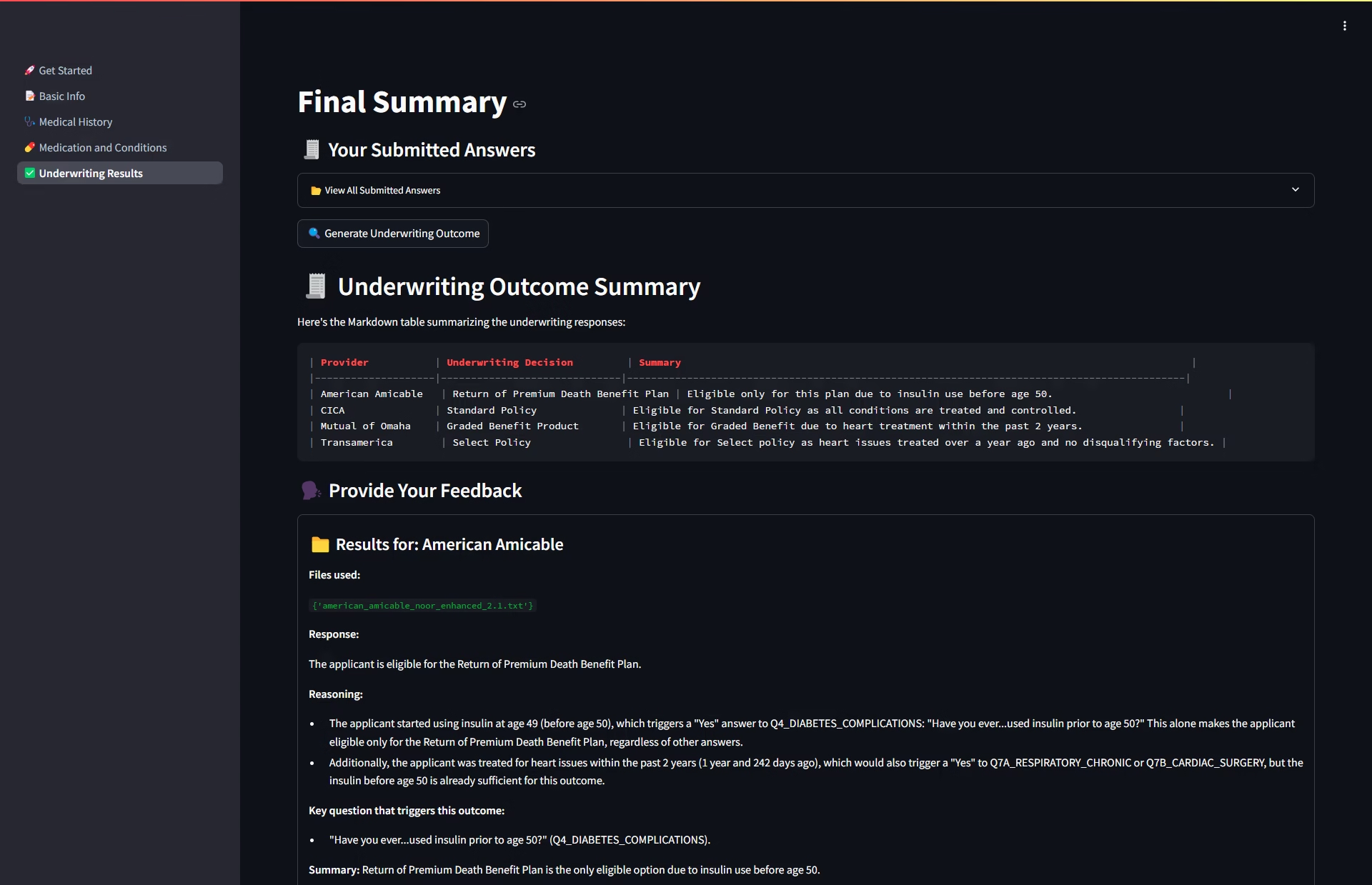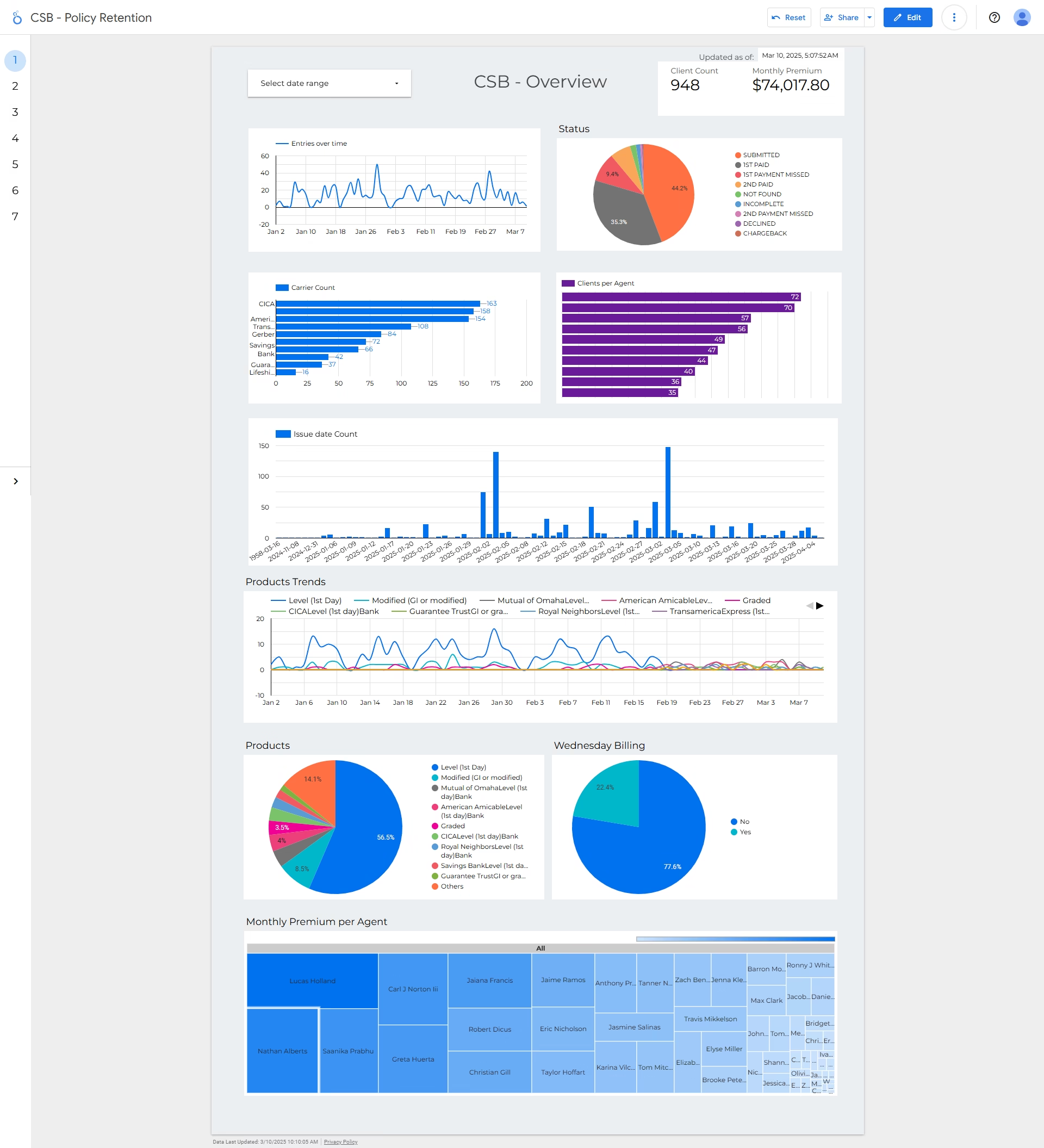
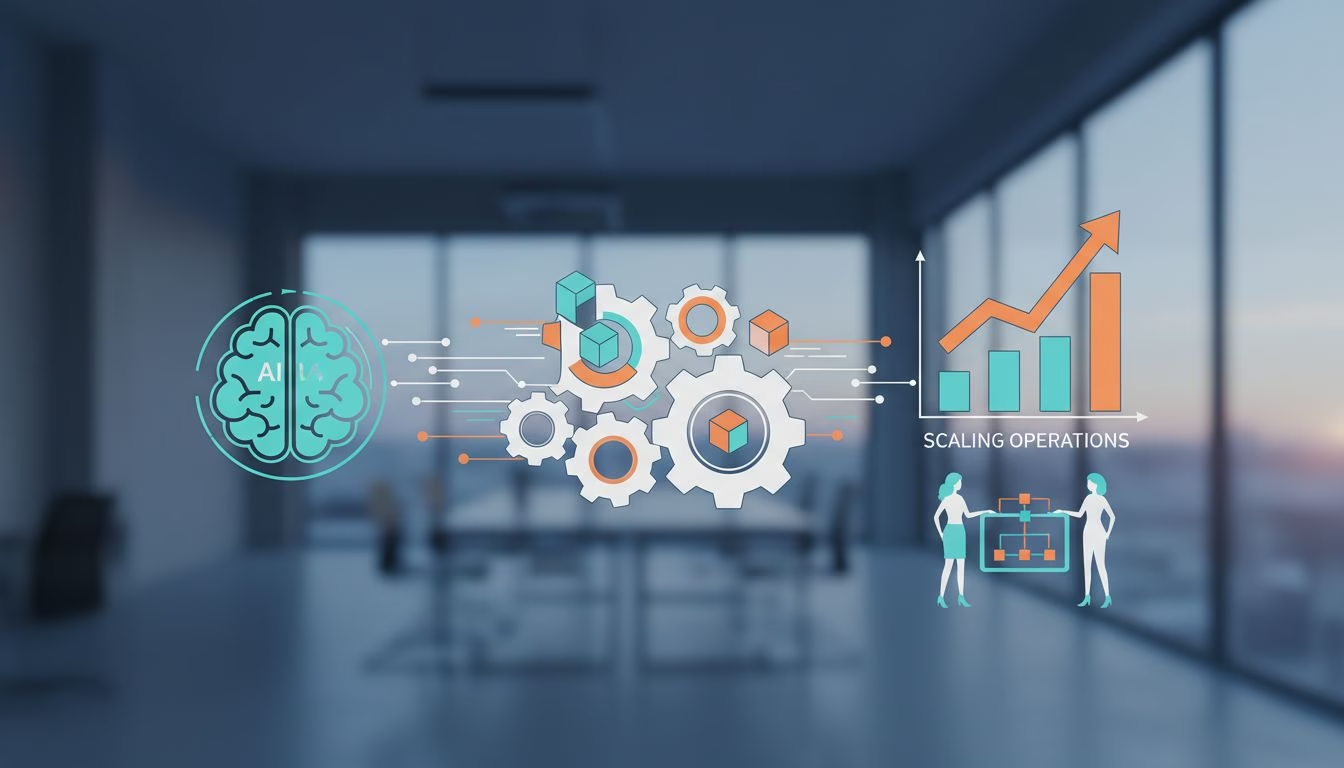
Lean operations teams are under pressure to deliver more output, faster decisions, and better service without adding proportional count. That is why AI-driven workflows and low-code tools are moving from experimentation into core operating strategy. Instead of using AI only as a writing assistant or chatbot, leading organizations are redesigning workflows so that AI can execute repeatable work, low-code platforms can connect systems, and people can focus on oversight, judgment, and exceptions.
Recent market signals make the shift hard to ignore. OpenAI reported on April 21, 2026 that more than 4 million developers were using Codex every week, up from 3 million earlier in the month, while Microsoft says Power Platform now has 56 million monthly active users. Together, those figures point to a practical reality for mid-size and enterprise teams: scalable operations increasingly come from orchestrating AI, automation, and data across workflows rather than hiring more specialists for every bottleneck.
Why lean teams are redesigning operations around AI execution
The biggest change in enterprise automation is that AI is no longer limited to assisting with isolated tasks. Recent OpenAI updates show that lean teams are using agents to execute end-to-end work such as test coverage, code review, incident response, and feature prototyping. That matters operationally because throughput gains no longer depend only on individual productivity; they come from redesigning the workflow itself so more work moves forward without manual intervention at every step.
OpenAI’s February 11, 2026 engineering post offered one of the clearest examples of this shift. The company described an internal beta built over five months with “0 lines of manually-written code” and in about “1/10th the time,” with every line of code, tests, CI, documentation, and tooling written by Codex. Humans did not disappear from the process. Instead, they focused on environment design, intent specification, and feedback loops, which is a useful model for operations teams trying to scale with limited staffing.
The phrase from that same post, “Humans steer. Agents execute.”, is becoming a strong operating principle for lean organizations. In practice, that means leaders define goals, policies, thresholds, and quality controls, while AI handles repeatable cognitive work inside a governed process. For operations leaders, this creates leverage not by replacing teams wholesale, but by shifting people to higher-value oversight and decision-making.
What AI-driven workflows look like in practice
Modern AI-driven workflows and low-code tools are most effective when AI is embedded directly into the flow of work rather than layered on as a side assistant. OpenAI’s November 7, 2025 case study on Notion described a rebuilt agent system with GPT-5 that could “reason, act, and adapt across workflows,” rather than simply respond to prompts. That distinction is critical because execution at scale depends on AI participating in orchestration, search, planning, and actions across business systems.
Notion’s experience also highlighted a practical threshold for value: “Agents needed to make decisions, orchestrate tools, and reason through ambiguity.” Lean teams run into ambiguous inputs every day, from incomplete intake requests to conflicting priorities and missing data. Workflows that can branch on context, call the right systems, and advance work without waiting for constant human routing can materially reduce delays.
This is why enterprise infrastructure providers are now framing agent workflows as production systems. On April 13, 2026, OpenAI said enterprises on Cloudflare Agent Cloud could deploy agents to handle work such as responding to customers, updating systems, and generating reports in a secure, production-ready environment. For lean teams, that changes the conversation from pilot projects to operating infrastructure, where AI becomes part of how work gets done every day.
Why low-code is the scaling layer lean teams need
AI execution only scales when workflows can be connected, standardized, and maintained without creating a dependency on scarce engineering resources. That is where low-code platforms matter. Microsoft says Power Platform now has 56 million monthly active users, up 27% year over year, and describes it as the most widely adopted low-code platform in the market. That level of adoption signals that low-code is no longer a niche option for departmental automation; it is a mainstream delivery model for enterprise workflow scale.
For lean teams, low-code provides the operational scaffolding around AI. It enables business users and technical teams to model workflows visually, connect systems, define approvals, set triggers, and standardize exception handling. Microsoft’s positioning is especially relevant here: Power Platform “makes it fast and intuitive to create intelligent apps at scale,” while also emphasizing managed security, governance, and deployment. Those controls are essential when operations teams want speed without introducing automation sprawl.
Low-code platforms are also evolving beyond simple if-this-then-that automation. In its May 19, 2025 Build announcement, Microsoft introduced Copilot Tuning and multi-agent orchestration, showing how low-code workflow stacks are becoming environments for coordinated AI systems. That means lean teams can move from automating isolated tasks to orchestrating more complex, multi-step processes that span departments, data sources, and business rules.
The best operating model is supervised autonomy
The strongest pattern emerging across recent sources is not full automation and not manual oversight of every task. It is supervised autonomy. OpenAI’s “Humans steer. Agents execute.” pairs naturally with UiPath’s April 30, 2025 model of combining “AI agents, robots, and people” on one system. In that model, structured and repetitive tasks are handled by deterministic automation, judgment-heavy but repeatable work is handled by AI, and people step in for exceptions, approvals, and sensitive edge cases.
This model is practical because not all operational work has the same level of variability. Invoice matching, status updates, field normalization, and routine report generation are ideal candidates for rule-based automation. Drafting responses, classifying requests, summarizing incidents, and identifying trends often benefit from AI reasoning. Escalations, policy interpretation, and complex stakeholder decisions still need human involvement. Lean teams scale faster when they assign each part of the workflow to the right execution layer.
UiPath’s market traction reinforces that this is not theoretical. The company says its platform is trusted by more than 10,000 leading organizations, and its January 27, 2025 report found that 90% of IT executives have business processes that would be improved by agentic AI, while 77% were prepared to invest in it that year. For operations leaders, the message is clear: supervised autonomy is becoming a budgeted and governed operating strategy, not an innovation side project.
Data integration is the difference between smart workflows and disconnected bots
Many organizations stall because they focus on model capability before fixing workflow context. ServiceNow’s 2025 messaging around Workflow Data Fabric and AI Agent Fabric makes the point directly: AI agents need trusted access to structured, semi-structured, unstructured, and streaming data across systems if they are going to make good decisions and take meaningful action. A workflow that cannot see current customer status, policy data, transaction history, or operational constraints will not scale reliably.
That is why data integration remains foundational to operational leverage. Lean teams can only automate intake, exception routing, forecasting, and reporting when AI and automation layers are connected to the systems where work actually lives. This is also where many initiatives fail. Gartner has warned that 60% of AI projects could be abandoned by 2026 because of a lack of AI-ready data. In other words, weak data readiness can erase the productivity promise of AI-driven workflows.
For organizations trying to move quickly, the implication is straightforward: start with the workflows where context can be assembled cleanly and action can be measured clearly. Connect ERP, CRM, ticketing, collaboration, and reporting systems through a governed integration layer. Then let AI operate inside that connected environment. At Statistique’s level of focus, this is where end-to-end automation and data integration create the real conditions for scalable, actionable intelligence.
Governance is what allows lean teams to scale safely
One of the most common misconceptions is that lean teams should prioritize speed first and governance later. In reality, recent enterprise platform strategies suggest the opposite. ServiceNow launched AI Control Tower at Knowledge 2025 on May 6, 2025 as a centralized layer to govern, manage, secure, and realize value from AI agents and workflows. Microsoft similarly emphasizes managed security and governance in its low-code stack, while Zapier continues to stress automation that is “approved by IT.”
This matters because governance over is often what stops smaller teams from scaling successful pilots. Once an AI workflow starts reading customer data, writing back to systems, sending communications, or triggering financial steps, leaders need clarity on permissions, auditability, escalation rules, and performance monitoring. Without those controls, every new automation creates risk and eventually slows adoption instead of accelerating it.
OpenAI’s own examples reinforce that high-performing agent workflows depend on harnesses and feedback loops, not just strong models. Lean teams should treat prompt instructions, test scenarios, approval paths, and exception logging as part of core workflow design. Governance is not bureaucracy in this context; it is the mechanism that makes AI execution trustworthy enough to operate at scale.
Where the biggest efficiency gains are showing up first
Operational productivity gains often start in places where teams lose time to search, coordination, and repetitive triage. Atlassian’s State of Teams 2025 report found that teams waste 25% of their time searching for answers, and Fortune 500 leaders observe 25 billion work hours lost annually due to ineffective collaboration. For lean teams, reclaiming even a fraction of that lost time can create meaningful capacity without changing count.
Service and support workflows are a strong early use case. Atlassian’s 2025 service management AI report found that 93% of organizations said AI increased efficiency, while 91% prioritized customer experience and 91% said AI is saving money. These numbers matter because they show value across cost, speed, and service quality rather than in a single metric. AI-powered intake, classification, summarization, routing, and response generation can remove substantial friction from customer-facing and internal service operations.
Incident and trend analysis is another area where lean teams can benefit quickly. Atlassian reports that 79% of teams are already exploring AI for incident trending, suggesting a broader shift toward AI for pattern detection and operational acceleration in high-stakes workflows. When AI can identify recurring failure modes, summarize probable causes, and trigger the next workflow step automatically, teams reduce both response times and management burden.
How to implement AI-driven workflows and low-code tools without creating chaos
The right implementation path is usually narrower than organizations expect. Asana noted on May 6, 2025 that more than two-thirds of organizations still fail to use AI beyond a few work processes. That gap suggests the opportunity is not simply adopting more tools. It is creating repeatable workflow templates that can be standardized, measured, and reused across functions. Asana explicitly framed these templates as a way to make “small teams into powerhouses,” including examples where AI reviews incoming requests and routes work in minutes.
Integration must be treated as a first-order design issue. Zapier reported in October 2025 that 92% of enterprises treat AI as a priority, yet 78% struggle to integrate it. That tells operations leaders something important: implementation friction, not enthusiasm, is the real bottleneck. Low-code integration layers help close that gap by connecting apps, data, and approval logic without forcing every workflow change through a major engineering cycle.
A practical rollout plan starts with one high-volume, rules-heavy process that suffers from delays or inconsistent handoffs. Map the workflow, identify decisions that can be automated, define exception conditions, connect the required systems, and measure outcomes such as cycle time, accuracy, SLA compliance, and manual hours saved. Once that workflow is stable, convert the design into a reusable operating template. This is how lean teams scale systematically rather than accumulating disconnected automations.
Looking a, the direction of the market strongly supports this model. Gartner said in July 2025 that 80% of enterprise software and applications will be multimodal by 2030, up from less than 10% in 2024. As AI-native interfaces become standard, lean teams will have more opportunities to orchestrate work through natural interaction, proactive automation, and embedded intelligence. The teams that prepare now by investing in connected data, governed low-code workflows, and supervised autonomy will be in the strongest position to scale.
The evidence from OpenAI, Microsoft, UiPath, ServiceNow, Atlassian, Asana, Zapier, McKinsey, and Gartner points in the same direction: lean teams do not scale operations by adding AI chat features to existing manual processes. They scale by redesigning workflows so that low-code tools standardize the process, AI executes repeatable cognition, and humans intervene where judgment, risk, or exception handling matters most. That operating model creates more than efficiency. It creates new execution capacity.
For operations, finance, and analytics leaders, the next step is not to ask whether AI belongs in the workflow. It is to decide where governed autonomy can produce measurable business impact first. Organizations that combine automation, data integration, and advanced analytics into a unified workflow strategy will be better positioned to replace manual effort, improve decision quality, and generate real-time insight at scale.