Field Sales App Rebuilt for the Porch: Dromo 2.0
Dromo's rep app, rebuilt: a map that reads at a glance, a door that names itself, visits that wait out a patchy signal, and a manual made of eight short videos. Installed from the browser on iPhone and Android.
- 5
- map colours, down from 24
- 60yd
- to name the door
- 8
- help videos, built in
- 3,300+
- automated tests
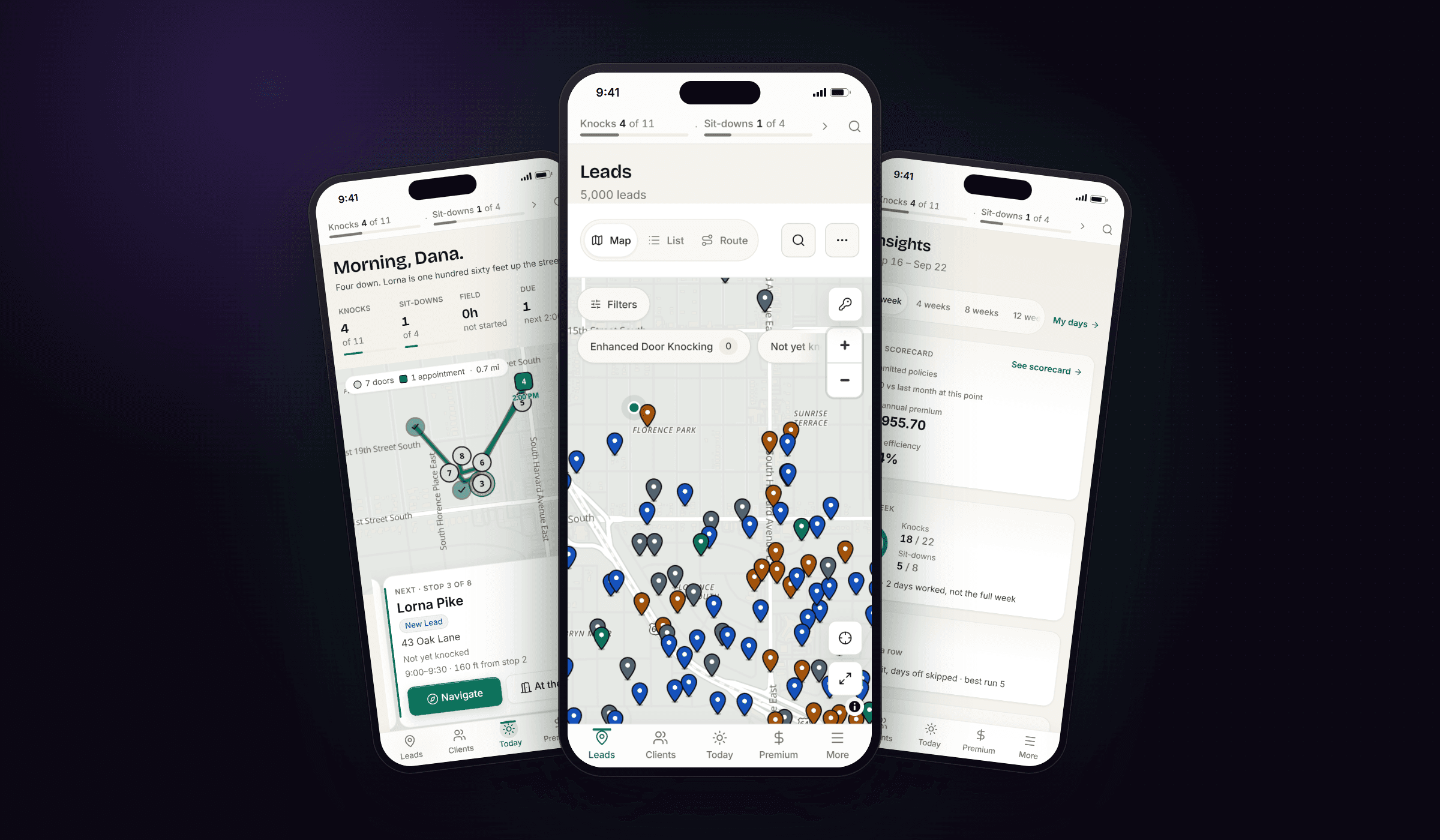
Dromo's back office decides what counts and what gets paid. This is the other half: the app in a rep's hand, on a sidewalk, between two houses, with three seconds to look at it. In September 2026 we rebuilt it around that moment.
The problem
A field rep's day happens on porches, not at a desk. The app has to say which house this is, take the visit in one tap, cope when the signal drops, and teach a new rep how it works without anyone standing next to them. The version before 2.0 painted every lead status in its own colour, 24 in all, and had no help built in.
What we built
A phone app, installed straight from the browser to the Home Screen on iPhone and Android, with no app store in between, that a rep runs the whole day on:
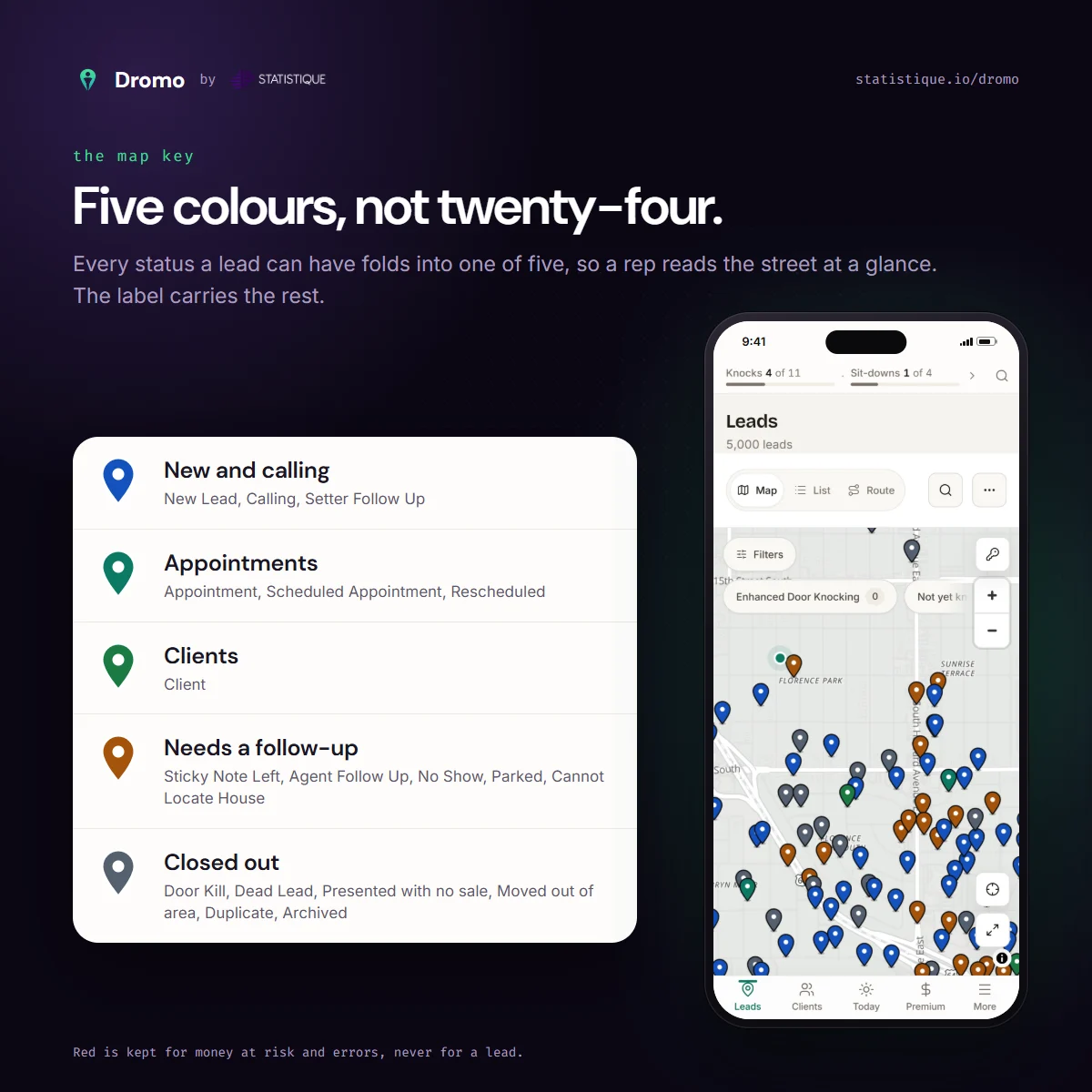
- A map you can read at a glance. Every status folds into five colours: new and calling, appointments, clients, needs a follow-up, and closed out. The label on the pin carries the rest, and red is never a lead colour; it is kept for money at risk and errors. A book groups into counted bubbles when zoomed out and breaks into single pins from a few blocks away. With 5,000 invented leads loaded, zooming back and forth across that hand-off held 60 frames a second, worst frame 19 ms, measured in a desktop browser sized as a phone.
- A door that names itself. Within 60 yards the app names the house, says how often it has been tried ("3rd time here"), fills the office's opener in for that homeowner, and logs the visit with one tap. Whether the knock counts is a separate, wider rule set by the back office. We wrote up why one radius cannot do both jobs.
- Visits that wait out a patchy signal. An outcome that cannot leave the phone is kept on it, shown as waiting, and sent by itself, oldest first, when the connection returns. A send that might already have landed is never repeated automatically: the rep decides, so no door is counted twice. More on how the queue works.
- The day in one sentence. Today opens with where things stand in words ("Four down. Lorna is one hundred sixty feet up the street."), then the numbers, the route and the next stop. Everything the rep owes lives in one list: overdue, today, upcoming.
- Numbers reps can check. Insights and a leaderboard, with the ranking rules one tap away under "How this is ranked".
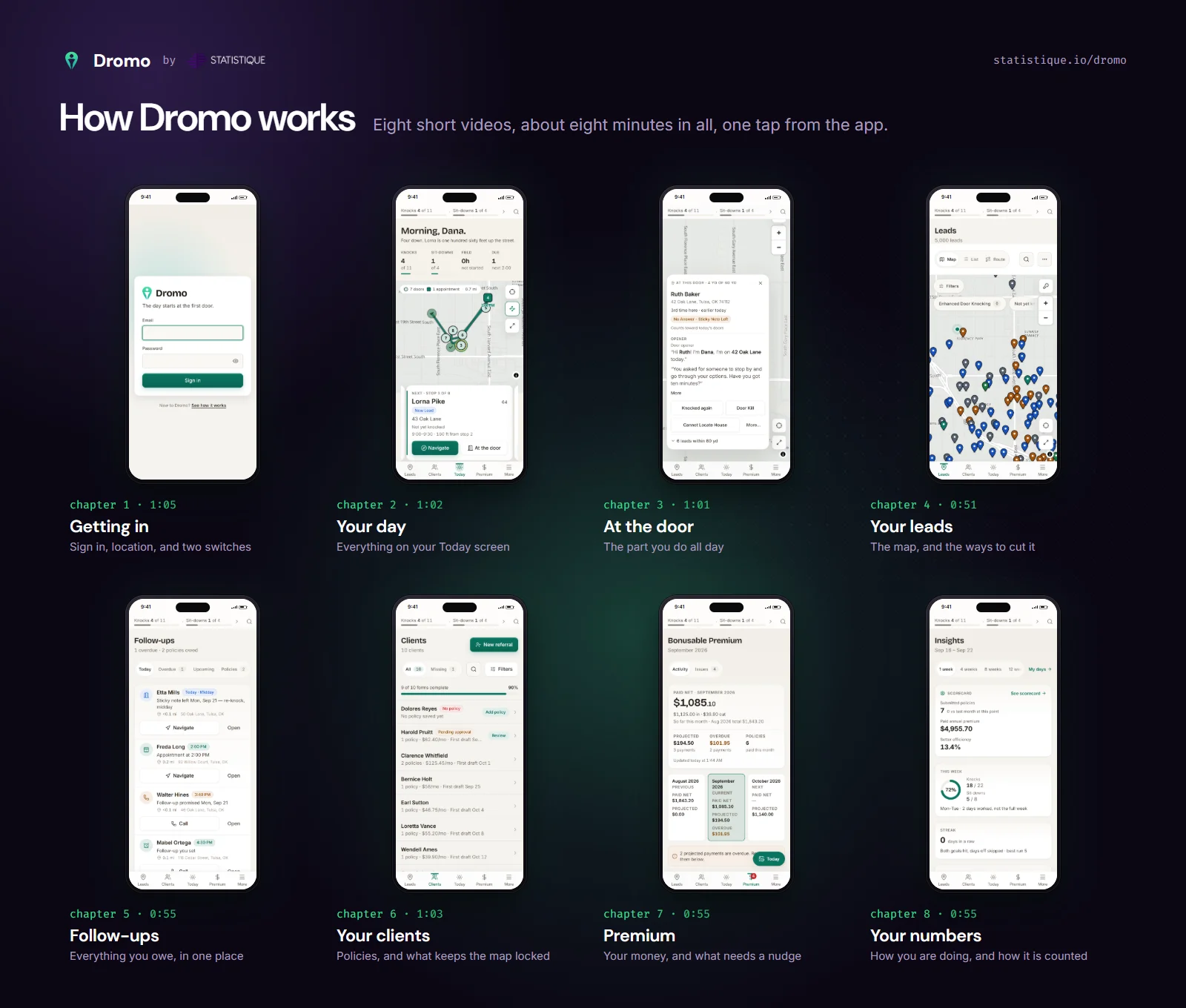
- A manual made of video. Eight voiced, captioned chapters of about a minute each, reached from the sign-in card, from More, and from the screen that asks for location.
What it proves
Field software earns trust on the porch. An app that names the right house, says out loud what it is still holding, and explains itself in a minute leaves a rep no reason to keep a second notebook. Behind it sit 3,349 automated tests in 206 files, all passing three full runs in a row on 22 September 2026, because the parts a rep would notice breaking are the parts that decide what gets counted.
The back office behind the app, from GPS-qualified activity to the payout engine, is written up in commission automation for field sales. The product itself is at statistique.io/dromo.
Every screen shown is Dromo's demo mode: the real app over an invented book.
Frequently asked questions
- What is Dromo 2.0?
- The rebuilt rep side of Dromo, Statistique's field sales app and CRM. Reps install it from the browser on iPhone or Android and run the day on it: the plan, a map of the book, the door they are standing at, follow-ups, clients and their own numbers.
- How does the app know which door a rep is at?
- It names a house only when the phone is within 60 yards of it, and only when the phone's own fix is accurate to 55 metres or better and no more than two minutes old. Whether the knock counts toward the rep's goal is a separate rule set by the back office, 250 yards by default.
- What happens to a visit logged on a weak signal?
- If the send fails, the outcome is kept in a queue on the phone, shown as waiting, and sent by itself, oldest first, when the connection returns. A send that may already have reached the server is never repeated automatically: the rep chooses, so no door is counted twice.
- Are the screens real?
- They are the real app running in its demo mode, over an invented book with invented reps and homeowners. No real rep, customer or address appears.