Understanding Teen Perceptions of Creative Industries
Topic modeling and survey analytics show how UK teenagers see creative careers, giving a fragrance association evidence for policy and youth outreach.
A leading fragrance-focused organization in the UK, working with a creative advocacy group, wanted to understand how teenagers view the creative industries — from fragrance design to music production. We analyzed their survey end to end: quantitative responses, open-ended text via topic modeling, and publishing-ready visualizations, delivering evidence the partners could act on in policy, initiatives, and engagement strategy.
The problem
The survey mixed structured questions — Likert scales, demographics — with open-ended prompts about creative pursuits. The structured data was straightforward to tabulate; the free-text responses, where teenagers explained their motivations and misgivings in their own words, were not. The clients needed both analyzed together: which groups are drawn to or put off by creative careers, what themes and barriers recur in their own words, and what to do about it.
How it works
Data preparation
We standardized and cleaned all responses to produce robust datasets, applying anonymization protocols throughout to protect respondent privacy.
Topic modeling of open-ended answers
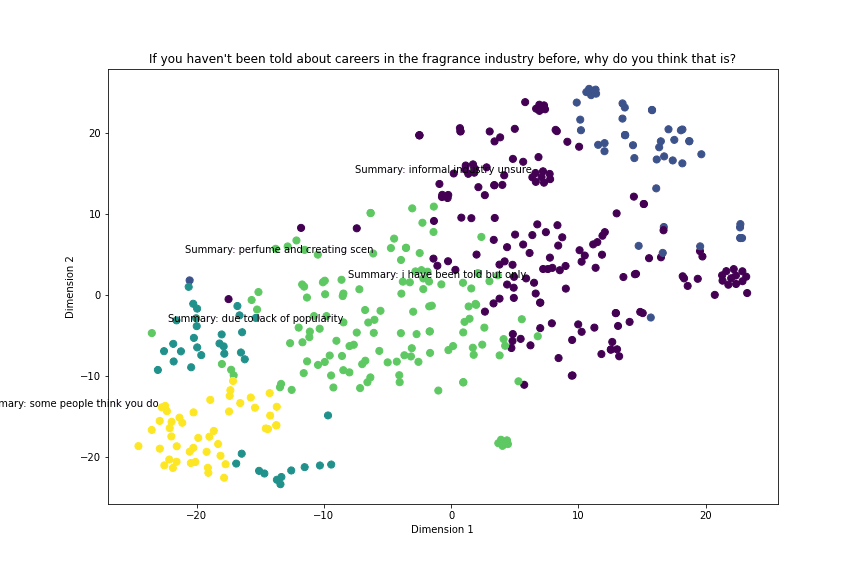
Using natural language processing — topic modeling methods such as LDA — we surfaced the underlying themes in free-text responses: industry misunderstandings, common motivations, and perceived challenges. Sentiment and contextual clustering then grouped feedback automatically, quickly flagging areas needing focused intervention, such as cost barriers or a perceived lack of diversity in certain creative sectors.
Quantitative analysis
Descriptive statistics and correlation analysis pinpointed the demographic groups and educational backgrounds most and least interested in creative careers. Cross-tabulation overlaid the open-ended sentiment onto demographics, showing how different groups of teenagers connect with each creative field, including fragrance.
Reporting
We built interactive dashboards summarizing trends, gaps, and suggested actions at a glance for policymakers and educators, plus infographics, charts, and story-driven briefs that made the findings legible to technical and non-technical audiences alike.
Recommendations
The analysis fed actionable roadmaps for addressing the most common barriers — cost, perceived irrelevance, and limited exposure — to shape future outreach and educational programs.
Impact
- Informed policy development. The findings shaped initiatives aimed at closing the gap between youth aspirations and practical opportunities in creative professions.
- Raised industry awareness. The visualizations and topic-modeling narratives sparked discussion at conferences and seminars, broadening awareness of teen viewpoints.
- New partnerships. The research helped fragrance companies, community hubs, and educational institutions form partnerships focused on developing young talent in design, art, and beyond.
- Sharper outreach. Evidence-based recommendations let the clients refine campaigns and focus resources where they resonated most with young audiences.